
Guides
Definition of Done: A Practical Guide for Agile Teams
Learn how to write, agree on, and use a Definition of Done that keeps your Agile team aligned on quality and delivery standards.
SprintsPlansJul 28, 2026
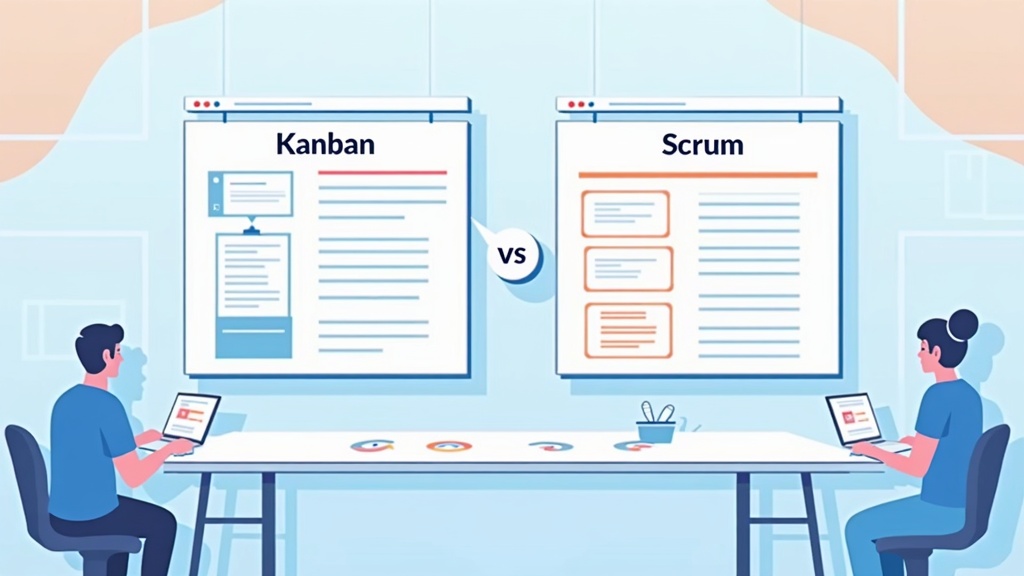
Kanban and Scrum are the two most widely adopted Agile frameworks. Both help teams deliver value iteratively, respond to change, and improve over time. Yet they organize work differently, impose different rules, and suit different contexts.
Related reading: agile metrics that matter:.
Related reading: agile metrics that improve.
Related reading: how to build an.
Related reading: agile principles in practice:.
Related reading: agile transformation roadmap for.
Choosing between them is not about picking the "better" framework. It is about matching a way of working to how your team receives work, delivers value, and learns. A marketing team handling unpredictable requests needs a different structure than a software team building features on two-week cycles.
This guide compares Kanban and Scrum across the dimensions that matter most, helps you identify which fits your situation, and explains when hybrid approaches make sense.
Scrum is a time-boxed framework built around fixed-length iterations called sprints, typically one to four weeks. Teams plan work at the start of each sprint, deliver a potentially shippable increment by the end, and reflect on their process in a retrospective.
Scrum defines specific roles, events, and artifacts:
Roles: Product Owner, Scrum Master, Development Team
Events: Sprint Planning, Daily Scrum, Sprint Review, Sprint Retrospective
Artifacts: Product Backlog, Sprint Backlog, Increment
The sprint creates a rhythm. Work enters the sprint through sprint planning, the team focuses on committed goals, and stakeholders see progress at the sprint review. The sprint retrospective closes the loop with process improvement.
Scrum works well when teams can forecast work in chunks, benefit from regular delivery milestones, and need structure to manage complexity.
Kanban is a flow-based method for managing work. It visualizes tasks on a board, limits work in progress (WIP), and optimizes how items move from start to finish. Unlike Scrum, Kanban does not prescribe fixed iterations or specific roles.
Core Kanban practices include:
Kanban suits teams with continuous, unpredictable incoming work — support queues, operations, content pipelines, and maintenance-heavy products.
Neither framework is inherently more Agile. Both embrace empiricism, transparency, and adaptation. The difference is in the structure they provide.
Scrum fits teams that benefit from time-boxed focus and regular stakeholder checkpoints.
Focus. A sprint commitment helps teams say no to distractions. When the sprint goal is set, the team has permission to defer new requests until the next planning session.
Predictability. Over time, velocity gives stakeholders a reasonable forecast of what the team can deliver per sprint.
Built-in improvement. The sprint retrospective is not optional. Teams that skip reflection without a forcing function often benefit from Scrum's prescribed retrospective cadence.
Clear accountability. Defined roles clarify who owns the backlog, who facilitates the process, and who builds the product. See our guide to Scrum roles explained for details.
Scrum can feel rigid for teams drowning in urgent, unplanned work. Committing to a sprint goal when priorities shift hourly creates friction. Teams that treat Scrum as pure ceremony — standups without empowerment, retrospectives without action — get the overhead without the benefit.
Kanban fits teams where work arrives continuously and priorities change frequently.
Flexibility. New high-priority items enter the queue without waiting for the next sprint. WIP limits prevent the team from taking on too much at once.
Flow optimization. By measuring cycle time and identifying bottlenecks, teams improve how work moves through the system rather than how much they commit per sprint.
Lower ceremony overhead. No sprint planning, no sprint review, no role requirements. Teams adopt practices as needed.
Gradual adoption. You can start by visualizing your current workflow on a board without restructuring the entire team.
Without iterations, teams may skip retrospectives and process improvement. Without commitments, stakeholders may struggle to forecast delivery. Kanban requires discipline around WIP limits and explicit policies — otherwise it becomes a sticky-note board with no behavioral change.
Continuous improvement is central to Agile regardless of framework. Scrum mandates retrospectives every sprint. Kanban recommends them but leaves timing flexible.
Teams using either framework benefit from structured reflection. A sprint retrospective surfaces what is working, what is not, and what to change. Kanban teams might retrospect monthly or when flow metrics show a problem. Scrum teams retrospect at a fixed frequency and length.
The format matters less than the habit. Teams that reflect regularly — using templates like Start Stop Continue or 4Ls — improve faster than teams that only optimize their board or sprint process.
Online retrospective tools like SprintsPlans support both Scrum and Kanban teams by providing a space to gather feedback, vote anonymously on priorities, and track action items over time. Whether you retrospect every two weeks or every month, having a consistent tool reduces friction.
Many teams do not choose purely between Kanban and Scrum. They blend elements in an approach sometimes called Scrumban.
Common hybrid patterns:
Hybrids work when your context does not fit a textbook implementation. A team handling both planned features and urgent bugs might sprint-plan feature work while maintaining a separate Kanban lane for interrupts.
The risk with hybrids is adopting the easy parts of each framework — boards from Kanban, standups from Scrum — without the discipline that makes either effective. WIP limits and retrospectives are non-negotiable regardless of label.
Answer these questions honestly with your team:
If you can forecast a sprint's worth of work with reasonable confidence, Scrum fits. If work arrives unpredictably throughout the week, Kanban fits.
Product launches, contractual deadlines, and executive reporting often favor sprint-based delivery. Internal tools teams with continuous deployment may prefer flow-based Kanban.
Scrum provides more structure for teams learning Agile. Kanban assumes the team can manage flow without prescribed roles and events.
If you need better focus and commitment, try Scrum. If you need faster flow and shorter cycle times, try Kanban.
If the answer is no, neither framework will deliver lasting improvement. Start by building a continuous improvement system before debating Kanban vs Scrum.
Teams switch from Scrum to Kanban (or vice versa) when their context changes — new product stage, different work type, organizational restructuring. Treat a switch as an experiment, not a failure. Run it for enough time to gather data, and retrospect on whether the change helped.
A Kanban board is a tool. Kanban the method includes WIP limits, flow management, explicit policies, and continuous improvement. A board without these is visualization, not Kanban.
Scrum's rules create useful constraints. Teams that find it rigid often struggle with sprint commitment discipline or stakeholder management, not Scrum itself. Adaptation within the framework — through retrospectives — is expected.
Agile teams inspect and adapt their process. The framework that worked for your startup may not suit your scale-up. Revisit the decision periodically.
Both frameworks plan. Scrum plans per sprint. Kanban plans continuously. The difference is timing and granularity, not whether planning happens.
Yes. Many teams use Scrumban or other hybrids. The key is being intentional about which elements you adopt and why.
Kanban does not mandate retrospectives, but they are strongly recommended. Flow metrics tell you something is wrong; retrospectives help you understand why and what to change.
Scrum originated in software but is used by marketing, HR, legal, and other teams that deliver work in iterations. The principles transfer; the artifacts adapt.
Kanban has a lower entry barrier — visualize your work and set WIP limits. Scrum provides more guidance but requires more structural commitment.
In Scrum, the Daily Scrum focuses on sprint goal progress. In Kanban, standups often focus on flow — what is blocked, what is nearing WIP limits, and what can move forward today. Both address common daily scrum mistakes like status-reporting instead of collaboration.
No. Physical boards work for co-located teams. Remote and distributed teams benefit from online tools for boards, planning, and retrospectives. The framework matters more than the tooling.
Kanban and Scrum are not competitors. They are different answers to the same question: how do we deliver value while learning and improving?
Choose Scrum when your team benefits from sprint rhythm, commitment, and structured ceremonies. Choose Kanban when your work is continuous, unpredictable, and flow optimization matters most. Choose a hybrid when your reality sits in between — and commit to the practices that drive improvement, especially retrospectives.
The best framework is the one your team will actually follow, reflect on, and adapt. Start with an honest assessment of your work patterns, try one approach with discipline, and use retrospectives to evolve from there.
Learn how to write, agree on, and use a Definition of Done that keeps your Agile team aligned on quality and delivery standards.

Run Sprint Planning around a clear Sprint Goal, realistic forecast, and actionable plan instead of filling capacity with disconnected backlog items.

Choose Agile metrics that reveal flow, quality, customer outcomes, and learning while avoiding targets that encourage teams to inflate estimates or hide problems.