
Project Management
How to Plan a Project Without Overplanning
Create a project plan that provides direction, ownership, and risk visibility without pretending every task and date can be predicted from the beginning.
SprintsPlans TeamJul 20, 2026

Projects become harder to control when uncertainty is hidden behind detailed plans and generic reports. Projects rarely fail because nobody could imagine a risk.
This guide explains the approach in practical terms: what it is, why it is useful, when to use it, how to apply it step by step, and which mistakes to avoid.
Project risk management is the ongoing process of identifying uncertain events, estimating their potential impact, selecting responses, and monitoring warning signs. A practical risk system is short, current, owned, and connected to real project decisions.
Projects rarely fail because nobody could imagine a risk. They fail because risks were discussed vaguely, had no owner, or were not revisited until they became issues. A weekly system keeps attention on the few uncertainties that could materially affect scope, time, cost, quality, or trust.
Use this system on projects with external dependencies, fixed launch dates, regulatory requirements, technical uncertainty, multiple vendors, or significant organizational change. It also works for small projects where a formal risk process would be excessive.
A launch depended on approval from an external compliance team. The risk was initially listed as approval may be late, which produced no action. The project manager rewrote it: because the compliance team has a four-week queue, approval may miss the release date, delaying customer onboarding. An owner booked an early review slot, created a document checklist, and defined a trigger date for activating a phased launch. The risk never became an emergency.
A risk is uncertain and may happen. An issue has already happened and requires active resolution.
No. Build detailed contingencies for high-impact risks or risks with clear triggers. Low-level risks may simply be monitored or accepted.
Focus on the highest-priority items, often five to ten. The full register can remain available for less urgent risks.
Risk management works when it changes behavior before a problem occurs. Keep risks specific, prioritized, owned, and tied to triggers. A short weekly review is more valuable than a perfect register that nobody uses.
Use SprintsPlans for a project risk retrospective: collect risks anonymously, group duplicates, vote on the most serious exposure, and convert the top item into an owned action.
Create a project plan that provides direction, ownership, and risk visibility without pretending every task and date can be predicted from the beginning.
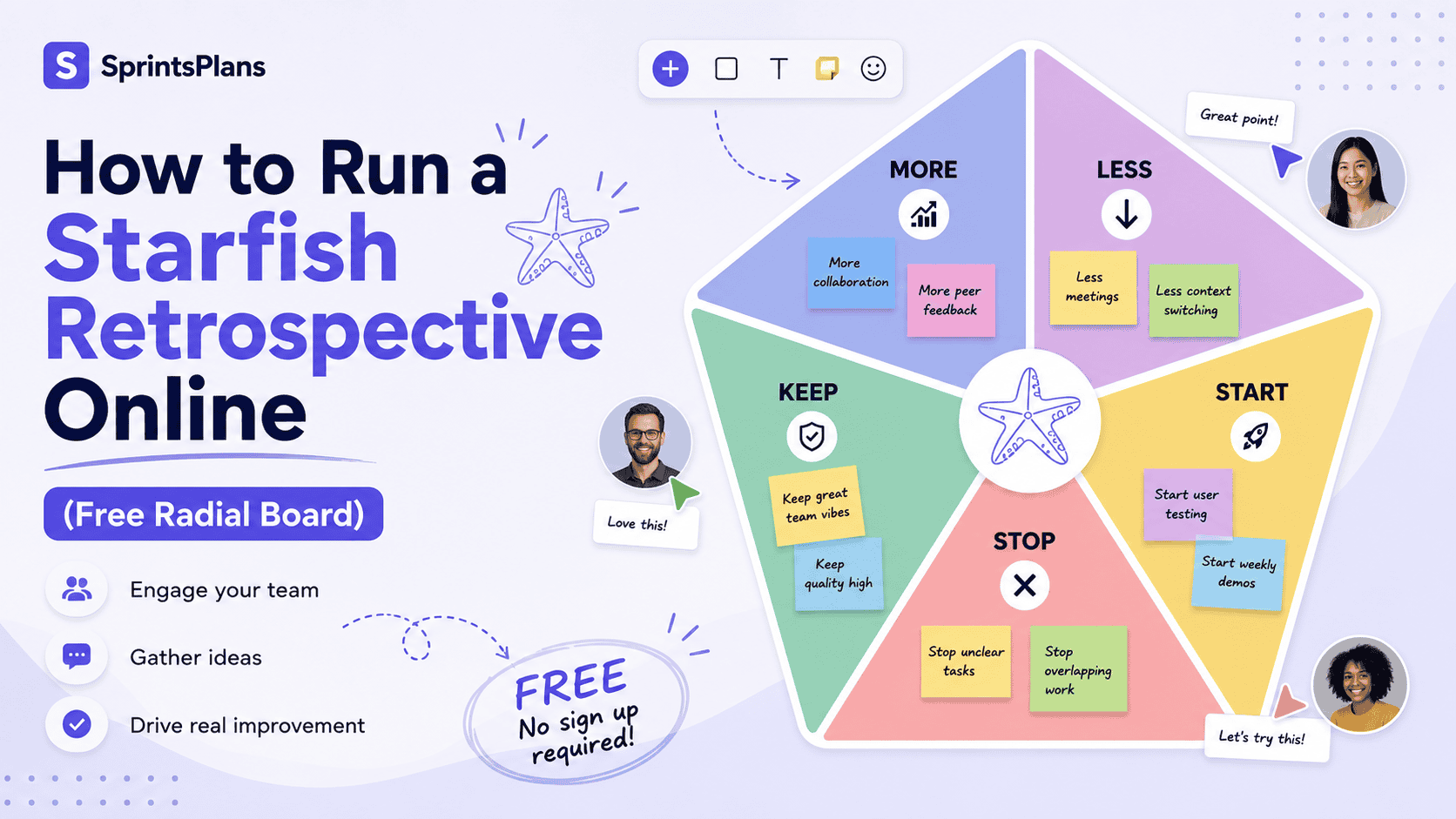
Run a Starfish retrospective online with a free radial board. Step-by-step setup, facilitation tips, and how remote teams get more from the five-arm format.

Learn what retrospective means in Agile and everyday work, why teams use retrospectives, and how a simple retrospective process can turn lessons learned into meaningful improvements.